
As always, I’m excited to share this installment of Safety Stop in my President’s Message. It is my goal to raise awareness about the risks associated with diving, and also underwater photography. I welcome your individual stories and submissions to the Safety Stop column so please don’t hesitate to email me at President@sfups.org. If you wish to share your article anonymously just let me know. In this month’s Safety Stop article, we will briefly touch on the topic of etiquette and integrity while performing underwater photography. The main goal of this column is to ensure the safety of divers, but let’s also look out for the safety of our beloved critters that we enjoy photographing. They rely on all of us to be mindful while we are photographing them. To my knowledge, there’s no such thing as “underwater police.”
A simple definition of integrity is doing the right thing when no one is watching. Good underwater photography etiquette means keeping your fins up, making sure all loose accessories are secured closely to your body, and not over-exposing critters sensitive to strobes and video lights. Keeping your body off the bottom will not only protect the small critters in the sand, it will also protect you from getting stung by scorpionfish and sea urchins. One trick I use to stay horizontal / parallel to the bottom is to have a 2 pound clip-weight attached to the D-ring on my chest strap. It helps me to have my dive profile point slightly downward with my fins up.
I’ve seen pictures of people holding starfish for a great photo op. Let’s please remind them that the oils from our hands can be harmful to them. The same holds true to our sensitive corals, but I’ve seen divers hold on to them to stabilize themselves in currents. Not touching the bottom is always your best bet when taking pictures. If necessary, the least / smallest point of contact to stabilize yourself in current is recommended (such as a muck stick.) Some dive locations have actually outlawed the use of muck sticks. While we are on the topic of buoyancy, let’s not forget about the importance of having a properly weighted camera rig. Many commercially available floats are available to achieve proper buoyancy of your camera rig.
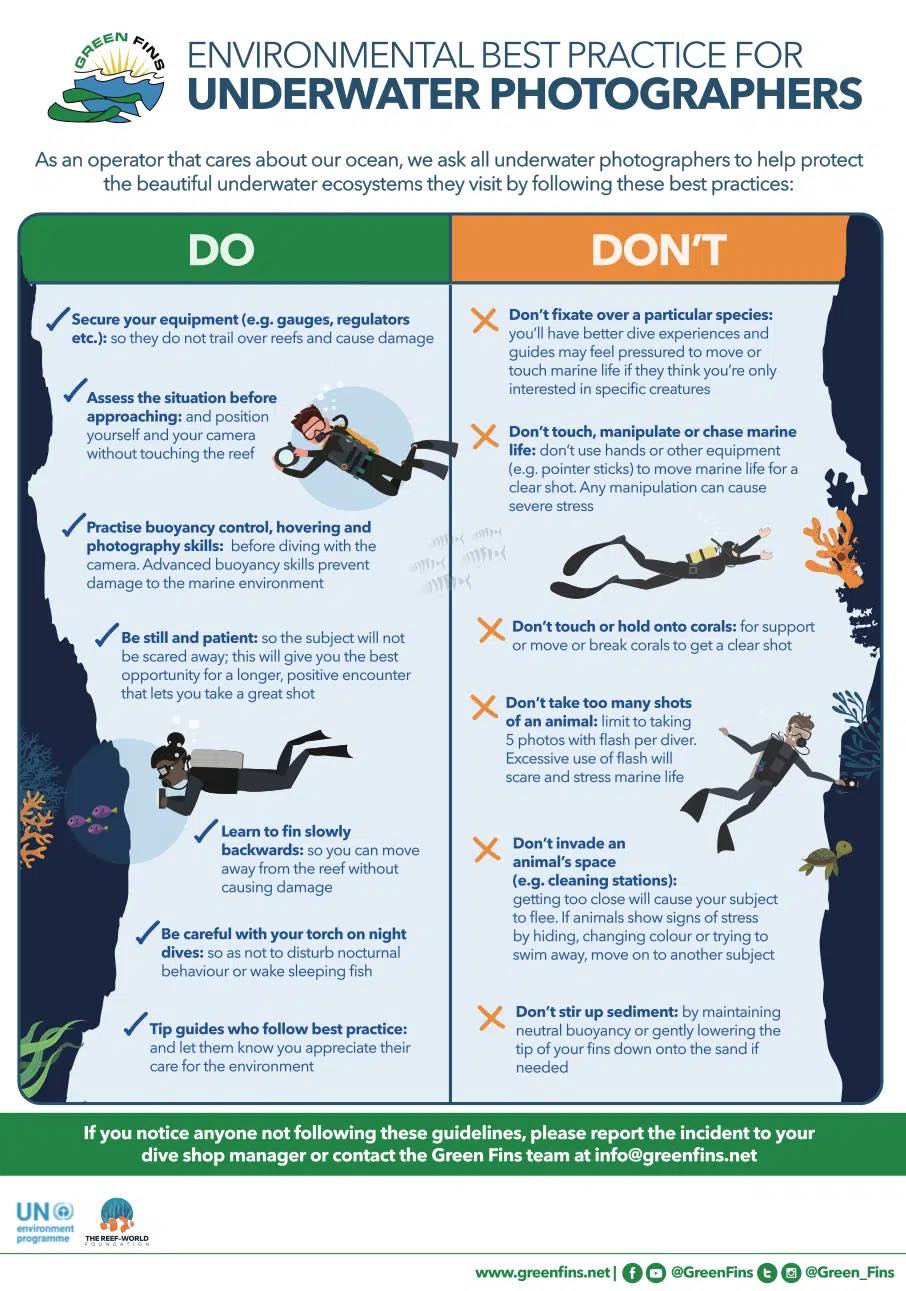
Feeding critters such as octopus and sharks is a controversial subject. I would imagine doing anything that changes their normal feeding behavior is often frowned upon as this associates humans with food. This not only affects their predatory methods, but it can also put people in danger.. The image below was shared by fellow SFUPS member Susan Bryan on Facebook. It lists several “do’s and dont’s” recommended for underwater photographers. Susan recommends to be the change you would like to see and shares the following phrase with us: “sea-monkey see, sea-monkey do.” Our beloved critters rely on us to police ourselves and be good stewards of the underwater environment. Let’s face it, no one is perfect, but let’s do our best to continually improve our underwater photography etiquette and techniques.